How to Sleep Deeper Naturally? Simple Habits That Improve Deep Sleep
Learn how to sleep deeper naturally with science-backed habits. Discover why you're not getting enough deep sleep and what to do about it tonight.
1/21/20268 min read


How to Sleep Deeper Naturally? 9 Habits That Actually Work
Key Takeaways
Deep sleep is the restorative stage where your brain detoxifies and your body repairs itself
Most adults only get 1–2 hours of deep sleep per night (13–23% of total sleep)
Small disruptions like room temperature, caffeine timing, and irregular schedules drastically reduce deep sleep
You can increase deep sleep naturally through simple evening habits, not supplements or gadgets
Many people start noticing improvements within about a week of consistent changes
You're sleeping 8 hours. You're following all the "rules." But you still wake up feeling like you got hit by a truck.
Here's the thing: total sleep time doesn't tell the whole story. If you're not cycling into deep sleep properly, your brain isn't getting the restoration it needs. It's frustrating, and honestly a little confusing.
The good news? You don't need a sleep tracker, expensive supplements, or a complete life overhaul. You just need to understand what deep sleep actually is and make a few targeted changes that protect it.
For me, the biggest surprise was that one small change (cooler room) did more than any supplement ever did.
This guide will show you exactly how to sleep deeper naturally, starting tonight.
What Deep Sleep Actually Is? (And Why It Matters?)
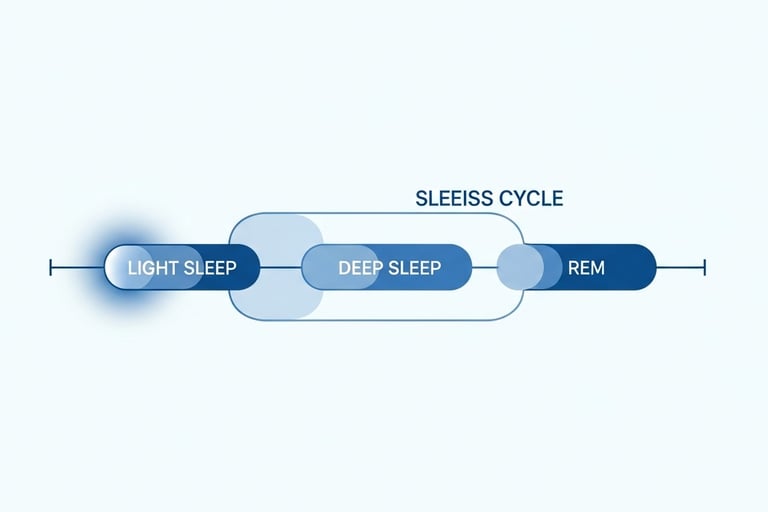
Deep sleep—sometimes called slow-wave sleep—is the third stage of your sleep cycle. It's when your brain waves slow down dramatically, your body becomes almost completely still, and the real restorative work begins.
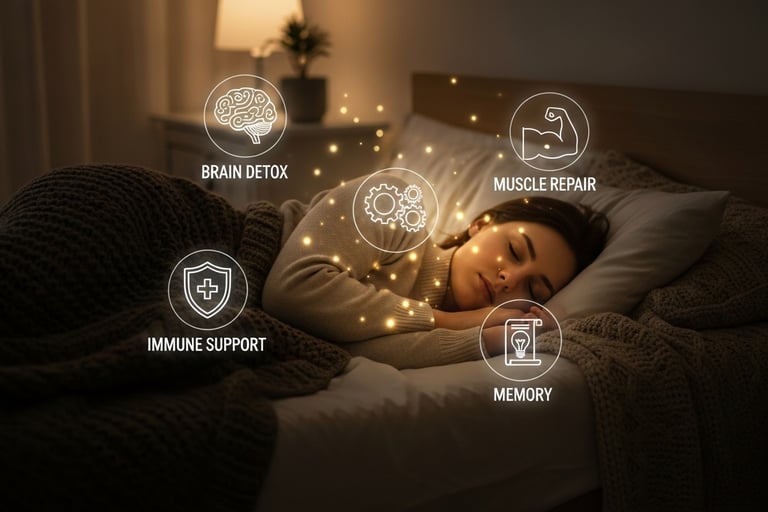
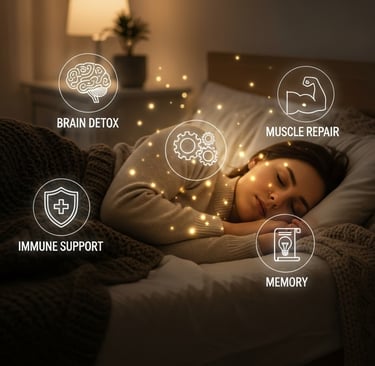
During deep sleep, your brain clears out metabolic waste (including proteins linked to Alzheimer's), your muscles repair, your immune system strengthens, and memories consolidate. This is where growth hormone gets released. This is when your nervous system calms down.
Most adults spend only 13–23% of their night in deep sleep. That's roughly 1 to 2 hours out of an 8-hour sleep session. And it mostly happens in the first half of the night, which is why protecting those early sleep cycles is so critical.
When you don't get enough deep sleep, you wake up tired even after a full night's rest. Your focus suffers. Your mood dips. You feel mentally foggy, emotionally fragile, and physically drained. I didn't realize this until I started paying attention to my mornings—it wasn't about how long I slept, but how well.
If you're curious about the broader picture of why sleep quality beats sleep quantity, check out our guide on how to improve sleep naturally.
Signs You're Not Getting Enough Deep Sleep
You might be low on deep sleep if you experience:
Waking up tired no matter how long you sleep. You hit snooze multiple times and still feel groggy an hour later.
Brain fog and trouble concentrating. Simple tasks feel harder than they should. You reread the same sentence three times.
Mood swings or irritability. You're more reactive, anxious, or emotionally flat.
Feeling physically weak or achy. Your muscles don't recover well from workouts, or you feel stiff in the morning.
Getting sick more often. Your immune system isn't rebuilding properly overnight.
Difficulty learning or remembering things. Deep sleep is essential for memory consolidation.
Sound familiar? You're not alone. Light sleepers, people under chronic stress, and those with inconsistent schedules are especially prone to shallow sleep patterns.
For a deeper dive into the "tired after sleeping" phenomenon, we wrote a full breakdown here: Why You Wake Up Tired Even After Sleeping.
Why Deep Sleep Gets Disrupted?
Here's where most sleep advice gets it wrong. People focus on falling asleep, but deep sleep is about staying asleep in the right stages. Several common habits sabotage your ability to cycle into deep sleep, even if you're technically "asleep" for 8 hours.
If your body is in bed, why does your brain still feel “on”?
Stress and Mental Overload
When your nervous system is in fight-or-flight mode, your body prioritizes vigilance over restoration. Elevated cortisol keeps you in lighter sleep stages. Your brain stays semi-alert, scanning for threats that aren't there.
Room Temperature
Your core body temperature needs to drop to enter deep sleep. If your room is too warm (above 68°F/20°C), your body struggles to cool down. This keeps you in lighter, more fragmented sleep.
Caffeine (Even 6 Hours Before Bed)
Caffeine has a half-life of 5–6 hours. That afternoon coffee at 3 PM? It's still in your system at 9 PM, blocking adenosine receptors that signal sleepiness. You might fall asleep, but your deep sleep suffers.
Alcohol
Alcohol might help you fall asleep faster, but it disrupts your sleep architecture. It suppresses REM sleep early in the night and fragments deep sleep cycles. You wake up more, even if you don't remember it.
Blue Light and Screen Time
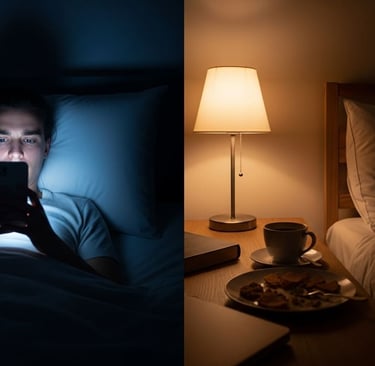
Bright screens before bed suppress melatonin production. But beyond that, scrolling activates your brain—checking emails, watching videos, reading news. Your nervous system stays revved up instead of winding down.
Late or Heavy Meals
Eating close to bedtime forces your digestive system to work overtime. Blood sugar spikes, insulin rises, and your body prioritizes digestion over deep sleep. The result? Shallow, restless sleep.
Irregular Sleep Schedule
Your circadian rhythm thrives on consistency. Going to bed at wildly different times confuses your internal clock. Your body doesn't know when to release melatonin or drop your core temperature, so deep sleep becomes erratic.
How to Increase Deep Sleep Naturally? Practical Habits That Work
These aren't theoretical tips. They're evidence-based habits that improve deep sleep when applied consistently. You don't need to do all of them at once—start with two or three that feel easiest, then build from there.
1. Stick to a Consistent Sleep Schedule (Even on Weekends)
Go to bed and wake up at the same time every day, within a 30-minute window. This trains your circadian rhythm to anticipate sleep and wake cycles, optimizing melatonin release and deep sleep timing.
Yes, even on weekends. Sleeping in throws off your rhythm for days.
2. Cool Your Bedroom Down
Aim for 65–68°F (18–20°C). If that's not possible, use a fan, crack a window, or try cooling sheets. Your body needs to lose about 1–2°F of core temperature to enter deep sleep efficiently.
3. Cut Caffeine After 2 PM
If you're sensitive to caffeine, try noon. The goal is to give your body enough time to metabolize it before bed. Switch to herbal tea, decaf, or just water in the afternoon.
4. Skip Alcohol (or Drink Earlier)
If you drink, finish at least 3–4 hours before bed. Better yet, experiment with a few alcohol-free nights and track how you feel. The difference in deep sleep quality can be dramatic.
5. Dim the Lights 1–2 Hours Before Bed
Lower the lighting in your home after sunset. Use warm, dim bulbs. Turn on night mode on your devices. This signals your brain that it's time to wind down and ramps up melatonin production naturally.
6. Exercise Daily (But Not Right Before Bed)
Physical activity increases deep sleep duration, especially aerobic exercise. Aim for at least 20–30 minutes of movement earlier in the day. Avoid intense workouts within 2–3 hours of bedtime—they raise your core temperature and rev up your nervous system.
7. Create a Wind-Down Routine
The last 30–60 minutes before bed should be consistent and calming. Read, stretch, journal, listen to soft music, or do breathwork. No work emails. No news. No scrolling. This is your transition time.
8. Eat Dinner Earlier and Keep It Light
Finish your last meal 2–3 hours before bed. If you need a snack, choose something small and easy to digest—like a banana or a handful of almonds. Avoid heavy, greasy, or spicy foods late at night.
9. Manage Stress During the Day
Deep sleep improves when your nervous system isn't chronically activated. Practice stress management techniques that work for you: meditation, walks in nature, therapy, creative hobbies, or simply saying no to things that drain you.
You can't always control stress, but you can control how you respond to it. Even five minutes of intentional breathing before bed can shift your body out of fight-or-flight mode.
Tonight's Quick Checklist
Ready to start improving your deep sleep tonight? Here's what to do:
Set a consistent bedtime and wake time (program it into your phone)
Lower your bedroom temperature to 65–68°F
Avoid caffeine after 2 PM
Skip alcohol tonight (or finish it by early evening)
Dim your lights 1–2 hours before bed
Turn off screens 30–60 minutes before sleep
Eat a light dinner at least 2–3 hours before bed
Spend 10 minutes doing something calming—read, stretch, breathe
FAQ: How to Get More Deep Sleep Naturally?
How much deep sleep should I get per night?
Most adults need 1–2 hours of deep sleep per night, or about 13–23% of total sleep time. If you're sleeping 8 hours, that's roughly 60–110 minutes. Quality matters more than hitting a specific number.
Can I increase deep sleep naturally without supplements?
Absolutely. The habits above—consistent sleep schedule, cool room, no late caffeine, stress management—are the foundation. Supplements like magnesium or glycine may help some people, but they're not necessary for most.
How long does it take to improve deep sleep?
Many people notice improvements within about a week of consistent changes, especially if you fix obvious disruptors like caffeine timing or room temperature. Bigger shifts in sleep architecture can take 2–4 weeks.
Do sleep trackers accurately measure deep sleep?
Consumer sleep trackers (like Fitbit or Oura) estimate deep sleep based on movement and heart rate. They're not as accurate as a sleep lab's EEG, but they can show relative trends. Use them as a guide, not gospel.
Does napping affect deep sleep at night?
Long or late naps can reduce your sleep drive and cut into nighttime deep sleep. If you nap, keep it under 20–30 minutes and finish before 3 PM.
Why do I wake up in the middle of the night even when I fall asleep easily?
Waking up in the middle of the night often signals disrupted sleep cycles, which can stem from stress, temperature, alcohol, blood sugar crashes, or sleep apnea. If it's chronic, talk to a doctor.
Final Thoughts: Small Changes, Big Difference
Deep sleep isn't mysterious. It's not something you're born with or without. It's the result of consistent daily habits that either support or sabotage your body's natural restoration process.
You don't need perfect sleep hygiene or a $3,000 mattress. You just need to remove the barriers and give your body what it needs: darkness, coolness, consistency, and calm.
Start with one or two of the deep sleep habits above. Track how you feel after a week. Then add another. What works for improving deep sleep is cumulative—small changes stack up fast.
Start small. Your sleep will usually follow.